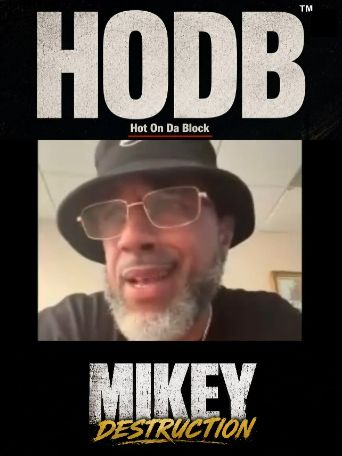
Mikey D, also known as MIKE Destruction, takes HODB back to the beginning of his story, growing up in Laurelton, Queens, during the 1960s and ’70s. He describes a time when neighborhoods were deeply connected, children spent their days outside, and families knew and looked after one another. Raised primarily by his grandparents, Mikey recalls how discovering hip-hop in 1979 changed the direction of his life. After hearing Grandmaster Caz for the first time, he immediately wrote his first rhyme, “Kim,” and began developing his voice as an MC. Hip-hop gave him confidence and allowed him to express things he previously didn't have the courage to say.
As a young rapper, Mikey became highly competitive and moved through several crews before connecting with local Queens pioneers who became mentors. One of the most notable relationships from this period was with a young James Todd Smith, who would become LL Cool J. Mikey recalls the friendship, their similarities as young MCs raised by grandparents, and the moment he suggested the name “Ladies Love” for Cool James—ultimately contributing to the name LL Cool J. Their paths eventually separated as LL pursued a record deal and Mikey remained deeply connected to the streets and his own competitive hip-hop journey. Mikey openly reflects on how ego, pride, and different life choices contributed to their distance.
Mikey's career continued to develop through his work with Paul C and the formation of the original L.A. Posse. He describes recording and releasing music during hip-hop's formative years, eventually signing with Sleeping Bag Records and becoming part of a roster that included major artists of the era. He also recalls winning the 1988 New Music Seminar Battle for World Supremacy, followed by the memorable and controversial battle involving Grandmaster Melle Mel. Throughout the interview, Mikey demonstrates a deep understanding of hip-hop history while emphasizing that his journey has always been about competition, creativity, authenticity, and earning respect within the culture.
Looking back across more than four decades, Mikey speaks about his music, collaborations, and evolution as an artist. He discusses projects and songs that remain meaningful to him, including “Over 50,” while explaining that his catalog represents different stages and flows of his creative life. More importantly, he wants his legacy to be that of someone who was true to the game, spoke from the heart, and encouraged others to discover their own potential. His message to the next generation is especially strong: don't chase waves—be the ocean and create the wave. He encourages artists to trust their instincts, protect their ideas, step outside their comfort zones, and pursue their own identity rather than allowing peers or trends to dictate their direction.
The interview ultimately becomes a story about legacy, growth, and transformation. Mikey clarifies misconceptions about his relationships with LL Cool J, Large Professor, and MC Search, explaining that much of what people perceived as “beef” was rooted in hip-hop competition rather than hatred. He also redefines the meaning behind “Mikey Destruction.” What once represented destroying microphones and MCs has evolved into something much more personal: destroying the old version of himself and building a better one. Today, he describes himself as accountable, respectable, and humble. After more than 40 years in hip-hop, his greatest message is that everyone has something inside them worth discovering—and that people simply need to tap into their potential and believe that they can do it too.